Behind the Scenes of Mystery Team: The 33-Day Shoot and the People Who Made It
The first time I watched Mystery Team it was on a slightly scratched DVD borrowed from a friend who kept insisting the boy detectives “get funnier the more you think about them.” He was right, annoyingly. What stuck with me afterwards, though, wasn’t one particular joke. It was the nagging sense that this little film had been a much bigger lift than it looked. These were the Derrick Comedy guys, after all, three young comedians best known for short videos people forwarded each other at work, and here they were with a proper feature, a mystery plot that actually had to add up, and an ending the characters had to earn.
So how did they pull it off? The honest answer is that we only know part of the story. Interviews given around the 2009 release paint a picture of a tight, carefully planned shoot, and that’s mostly what this piece is built on. Where the record runs out, I’ll say so.
A short shoot after a very long draft
The number people tend to quote is thirty-three. In a cast interview with College Movie Review, the group described a reported 33-day shoot, which isn’t much time at all for a feature with a cast this size and a story that keeps moving from location to location.
What makes it work, as far as anyone can tell, is everything that came before. The same conversation suggests the script had been written and rewritten for something like a year and a half, maybe longer. I’d treat those figures as memories rather than gospel, since nobody has published a day-by-day production log, but they sound about right for a group that clearly sweated the details.
You can see why it mattered once you remember what the film is. Jason, Duncan and Charlie are three teenage “detectives” who peaked when they were about eight. A little girl asks them to solve a real murder, and suddenly the clues have to connect, the red herrings have to be fair, and the audience has to be able to follow the case. With only a month of cameras, there was no room to work that out on the day.
Mysteries punish loose ends
I once tried to write a short whodunit for a community theatre group, and it taught me how unforgiving the genre is. A sketch can end on a punchline and nobody asks questions. A mystery gets picked apart. Somebody in the third row will always remember that the butler said he was in the garden, and they’ll want to know why he had mud on his shoes in act one and not act two.
Writers of detective stories have argued for about a century over what makes a mystery “fair,” going back to the rule lists crime novelists drew up in the 1920s and 30s. The basic idea is simple enough. The audience should be able to solve the case from what they’ve been shown. Mystery Team plays that for laughs, since its heroes are hopeless at it, but the joke only works if the real clues are sitting there in plain sight for the viewer.
That’s a lot of planning for a comedy. Every misreading by Jason, Duncan and Charlie has to point at something that’s actually in the scene, which means props, lines and locations all have to line up across shots that might be filmed days apart and out of order.
Why the jokes were written first
Anyone who’s watched early Derrick sketches knows how loose they could feel, like the scene was being found in the moment. A feature doesn’t really allow that. In a conversation with ComingSoon, Donald Glover talked about the writing process as something closer to a writers’ room, with the group hammering out the screenplay together before anyone stepped on set.
Part of the reason was purely practical. Glover was writing for 30 Rock at the time, and his television schedule squeezed the window when filming could actually happen. He said there wasn’t much time to improvise once the cameras rolled. If a scene didn’t work on paper, they couldn’t count on rescuing it on the day.
That doesn’t mean nobody ever riffed. Looking back years later, D.C. Pierson made a point in his retrospective interview that I think gets it exactly right. Because the scenes already worked, the performers were free to make them better. They weren’t standing around hoping inspiration would show up and save a shaky page.
More than three guys in sweaters
It’s easy to think of Mystery Team as the Glover, Pierson and Dierkes show, and on screen it mostly is. Behind the camera it was a much bigger group. Dan Eckman directed and edited the film, and Meggie McFadden produced it. Anybody who wants the full list of names, from cinematography and casting to production design, costumes and sound, can find it in the Rotten Tomatoes cast and crew listing.
I find that list oddly moving, if I’m honest. Every one of those names represents somebody who turned up early, hauled gear, fixed a costume or chased a noisy truck off a street so a take could finish. A piece in New Hampshire Magazine, which collected memories from the people behind the scenes, makes a similar point. The production leaned on a wide web of friends, local helpers and working professionals to get through it.
Small-town locations and long days
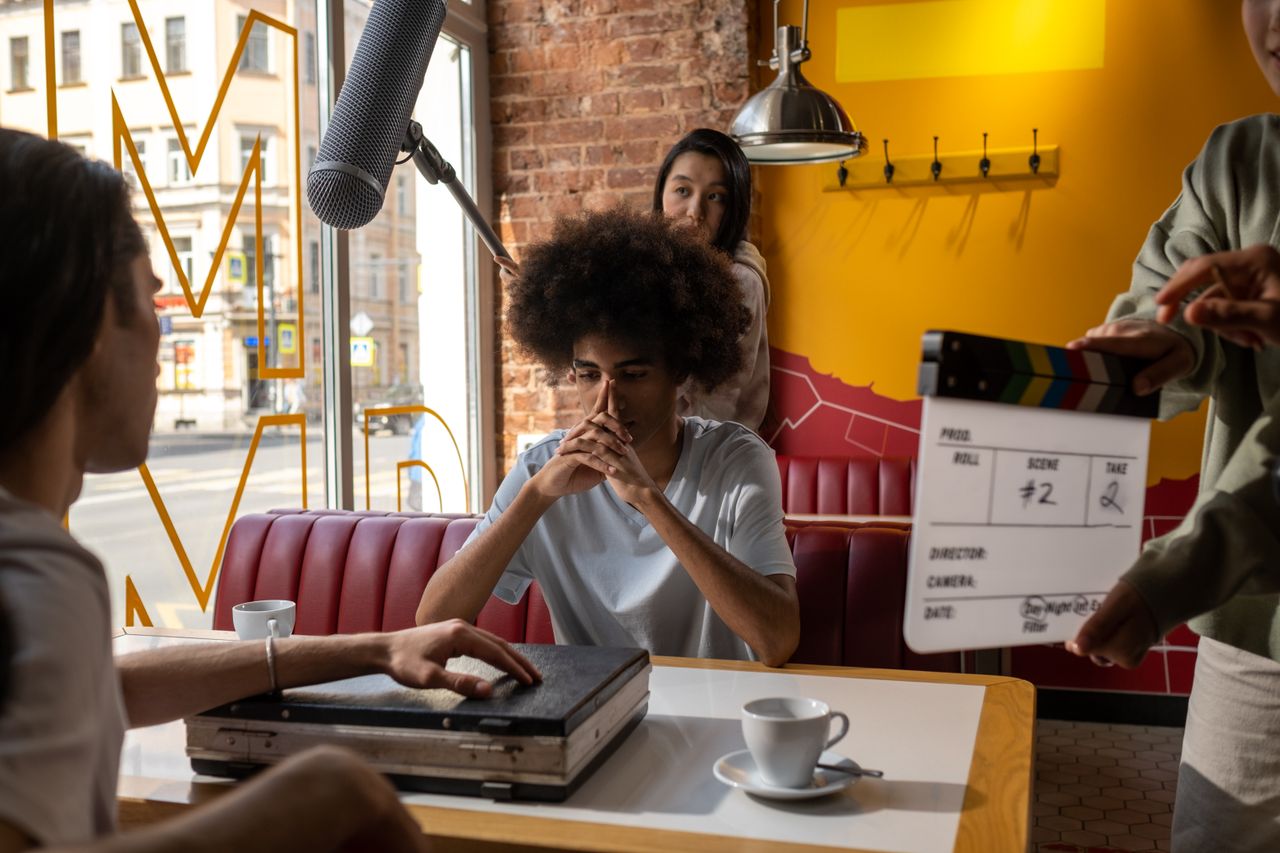
A lot of the film was shot in New Hampshire, with the main performers travelling up to join the crew. If you’ve never been on an independent set, the rhythm can come as a surprise. Hours go into lighting, sound, wardrobe, moving vehicles and checking that a coffee cup is in the same spot it was two takes ago. Then the actual performance happens in a few minutes, and the whole cycle starts again.
What do people do while all that is going on? Crews everywhere fill those gaps somehow, with phone puzzles, snacks, quick casual games or just a nap in a parked van. I’d love to tell you what the Mystery Team crew got up to, but I can’t. None of the sources I’ve read mentions it, and I’m not going to invent a cosy story about card nights in a New Hampshire motel just because it would make a nice paragraph.
There’s a reason I’m stubborn about this. Without a proper diary of the shoot, every made-up anecdote tends to get repeated until it sounds like fact, and fan sites are where that usually starts.
A film about growing up, made by people growing up
Here’s the part I find most interesting. The plot is about a group of former child detectives who badly want to be taken seriously by adults. The filmmakers were in a strangely similar spot. Derrick Comedy had a big online audience, but a feature film was a different kind of test, and plenty of people in the industry probably still saw them as “those internet guys.”
Dan Eckman drew that connection himself when he spoke to Filmmaker Magazine at Sundance in January 2009. His interview with Filmmaker Magazine is short, but it captures the film at a very particular moment, right where internet comedy, independent production and the festival circuit were all starting to overlap.
Watching it now, knowing what Glover went on to do, it’s tempting to read the whole thing as a launch pad. At the time, though, it was simply a group of friends trying to prove they could make something longer than five minutes without it falling apart.
What we can say, and what we can’t
Let me be clear about where the solid ground is. We know who made the film and who starred in it. We know about the reported thirty-three days of shooting, the long writing period beforehand, the New Hampshire locations and the Sundance premiere. Those all come from people who were there or from journalists who spoke to them.
What we don’t have is a full shooting diary, any detailed account of the cast’s private routines, or a reliable record of what anyone did during breaks. If any of that ever surfaces, from a former crew member or an old production binder found in someone’s attic, I’ll be the first to add it here with a clear note on where it came from.
For a broader look at how the project came together, from the early sketches to the final cut, our feature on the making of Mystery Team picks up the story from a slightly different angle.
One more viewing
I rewatched the film again before writing this, on a laptop this time and not a scratched DVD. Knowing a bit more about how it was made changed how I saw it. The scenes that look effortless suddenly look planned, and the small background moments feel like somebody’s very long afternoon. That’s probably the best compliment you can pay a thirty-three-day shoot.
Sources and context
- College Movie Review — Mystery Team cast interview
- New Hampshire Magazine — Behind the scenes
- ComingSoon — Donald Glover interview
- Filmmaker Magazine — Dan Eckman at Sundance
- Rotten Tomatoes — Full cast and crew
- D.C. Pierson retrospective interview
Editorial note: This is a newly written historical feature, not recovered copy from the original 2009 movie website. Images, if supplied, are illustrative stock photography unless stated otherwise.
Featured image: illustrative stock photography by Ron Lach / Pexels (photo source) · Pexels License. Not an original Mystery Team production photograph.